
Unconditional Solidarity: When Protecting Life Also Means Standing Together
Updated: Jun 9

During March and April, in La Moskitia, Honduras, conservation became more than just a temporary effort. It became a deeply human experience. An experience marked by constant rain, long walks through the forest, nights of watching over nests, exhaustion, uncertainty, and also hope.

The Unconditional Solidarity Campaign was not created only to monitor scarlet macaw nests. It was born because there came a moment when protecting life required more than knowledge and experience. It required human presence. It required support. It required solidarity.
Behind this initiative is One Earth Conservation, an organization whose vision and commitment to life has helped shape and sustain this work beyond borders. Within the organization, its co-directors have been essential not only in building the campaign, but also in shaping its spirit: a way of understanding conservation through care, trust, and unconditional solidarity.
From this shared vision, two women helped carry the living heart of this initiative from different, yet deeply connected, places.
In the forests of La Moskitia, where rain becomes part of the journey and every day demands patience and presence, Dr. LoraKim Joyner was never simply an outside observer. She became fully part of the daily life of the territory. Her time in the field during these two months reflected a kind of conservation that is not only studied but lived. Walking through difficult terrain, listening to the rhythms of the forest, and sharing moments of uncertainty and hope, she represented a deeply human kind of leadership built through closeness, humility, and constant dedication to life. Through her presence, conservation became relationship: an ongoing act of care, attention, and love for all living beings.

From another place, but equally connected to every step of the process, Ms. Gail Koelln became a constant source of support that helped sustain the larger vision of the campaign. Her work appeared in quieter but equally important ways: through guidance, trust, and ongoing support that allowed the experiences from the field to continue reaching a global conservation community. Even though she was not physically in La Moskitia, her commitment was present in the strength of the relationships built, in the support given to the team, and in the belief that solidarity can cross all borders and distances.

Together, they represent something greater than titles or roles: a shared love for life expressed through care, trust, human connection, and the belief that conservation is only truly possible when it is rooted in unconditional solidarity and transformed into action.
And perhaps that is the biggest reflection behind this entire experience:why does conservation have to become an act of unconditional solidarity?
The answer can be found in every day lived in the territory.
From the beginning of the campaign, the team faced heavy rains, long patrol days, and the constant risk of nest poaching. While some monitored giant trees during storms, others repaired wooden bridges, cooked in temporary camps, or walked for hours to check if a chick was still alive.

But at the same time, something else was happening.
People were beginning to find each other.
Indigenous communities, university students, conservationists, military members, priests, volunteers, environmental organizations, and people from different countries came together around one shared purpose: protecting life in La Moskitia.
And that changed the meaning of conservation.
Because conservation stopped being only about saving birds. It also became about supporting communities that have often been forgotten or ignored. It meant listening to the people who live in and depend on the forest. It meant recognizing the role of women patrol members, young students, camp cooks, and those who protect nests during the night while part of the forest sleeps.
Every daily update showed an important truth: conservation happens under extremely difficult conditions.
While about 114 active nests were protected, constant poaching was also taking place. While some chicks survived, others disappeared because of illegal wildlife trafficking. While the team spoke about hope, they also urgently asked people to stop the demand for, buying of, and selling of parrots.
That constant tension between beauty and danger shaped the spirit of the campaign.
That is why solidarity became essential. The voices of many different people became essential. Saying “thank you,” “we count on your support,” “help the world see this reality,” and “we are all one” became essential.
Not as a romantic or abstract idea, but as a real human need in order to continue physically and emotionally in the territory.
Solidarity meant sharing food in the rain.
It meant camping together in remote places.
It meant joining night patrols.
It meant blessing the leg bands of two chicks before placing them.

It meant university students teaching children about conservation.
It meant entire communities protecting the trees where scarlet macaws nest.
It also meant taking a moment to swim in the river and remember that even those who protect life need time to breathe and restore their spirit.
Throughout the campaign, one message became clearer and clearer: no one conserves alone.
The support of partner organizations, local communities, and many institutions allowed the work to continue even under the most difficult conditions. Their participation represented more than logistical help. It represented trust, commitment, and a powerful way of saying:“We are with you.”
And that means a great deal in places where people often feel forgotten.
Maybe that is why the campaign spoke so much about love, hope, and solidarity. Because the people who were in La Moskitia understood something very important: protecting scarlet macaws is not only about saving an iconic species. It is also about protecting the possibility for places where life continues to survive.

In the middle of environmental destruction, illegal trafficking, and biodiversity loss, unconditional solidarity became a form of resistance.
A deeply human form of resistance.
Because as long as someone is willing to walk miles with blisters on their feet to protect a nest, as long as a community continues to defend the forest, and as long as a child learns that parrots belong in the sky, and not in cages, there will still be hope.
And perhaps that is the true legacy of this campaign.
Not only the protected nests.
Not only the birds that were saved.
But the understanding that protecting life can also teach us how to care for one another.
And it was precisely by observing this experience from outside the territory that many of these reflections began to grow inside me.
During these months, my place within the campaign was not in the forest or walking with the patrols. My experience happened from another space: helping daily with online communications, publications, events, human connections, and ongoing conversations with people and institutions from different parts of the world who were beginning to connect with this reality.

But even from a distance, something inside me began to change deeply.
Every report from La Moskitia, every livestream, every story of exhaustion, hope, poaching, or resistance revealed something much larger than a conservation campaign.
Because perhaps the hardest question does not come only from the forest, but also from the world we have built outside of it.
Why have we reached a point where campaigns of solidarity are needed to defend life?
We live in a world that moves too fast. A world that has often made us stop truly seeing one another. We have lost the ability to pause, listen, and recognize ourselves in others. Little by little, we learned to measure everything through usefulness, consumption, or immediate benefit. And within that way of thinking, even life itself starts to have a price.
Illegal wildlife trafficking painfully reflects that reality. Parrots are taken from their nests, sold as products, and turned into objects inside a system that forgets that behind every species there is a story, a territory, and a living balance that also sustains human life.
But this campaign also showed the opposite.
It showed that there are still people capable of caring without expecting anything in return. People willing to walk through rain to protect a nest, support communities, share food, listen, teach, and keep hope alive even in moments of exhaustion.

And maybe that is one of the deepest lessons of this experience: unconditional solidarity should not exist only as an emergency campaign against destruction.
It should become a way of life.
It should become a genuine way of relating to the planet, to animals, and to one another. A way of remembering that protecting life does not only mean saving species, but also recovering our ability to feel, support each other, and recognize ourselves once again as part of something shared.
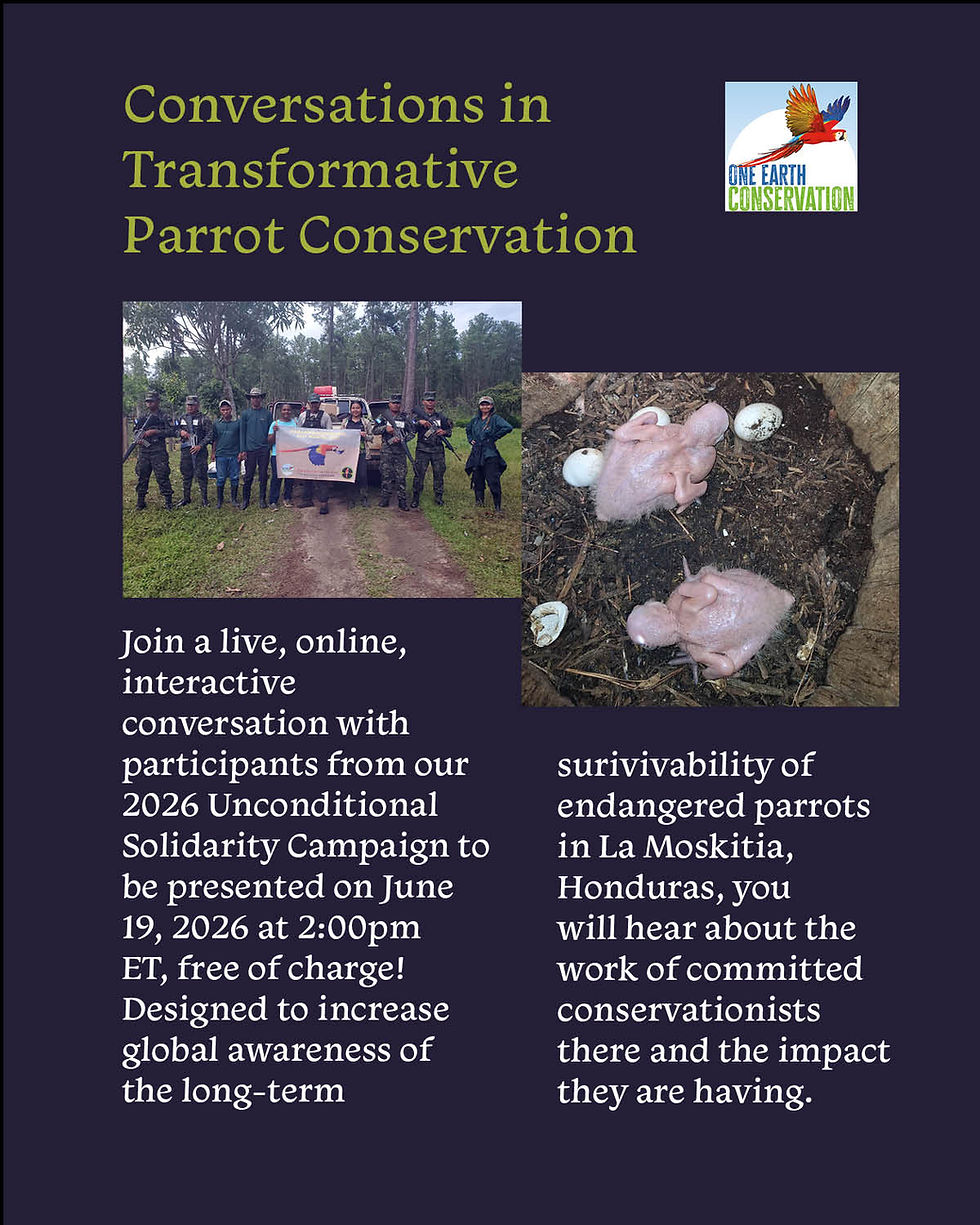
To explore these ideas in more depth, consider joining OEC’s online Transformative Conservation Conversations in June and July or our new online series, beginning in September, Transformative Unconditional Solidarity. Check out our events page on our website now and in the coming months for more information: https://www.oneearthconservation.org/events.


I really enjoyed reading this content. Thank you for providing such unique and useful information. Your point of view is excellent, and I fully agree with what you've shared. Thanks for sharing your thoughts with us! Marta Kostyuk 2026 US Open Red Dress
I really enjoyed reading this content. Thank you for providing such unique and useful information. Your point of view is excellent, and I fully agree with what you've shared. Thanks for sharing your thoughts with us! Dumb And Dumber Tuxedo